

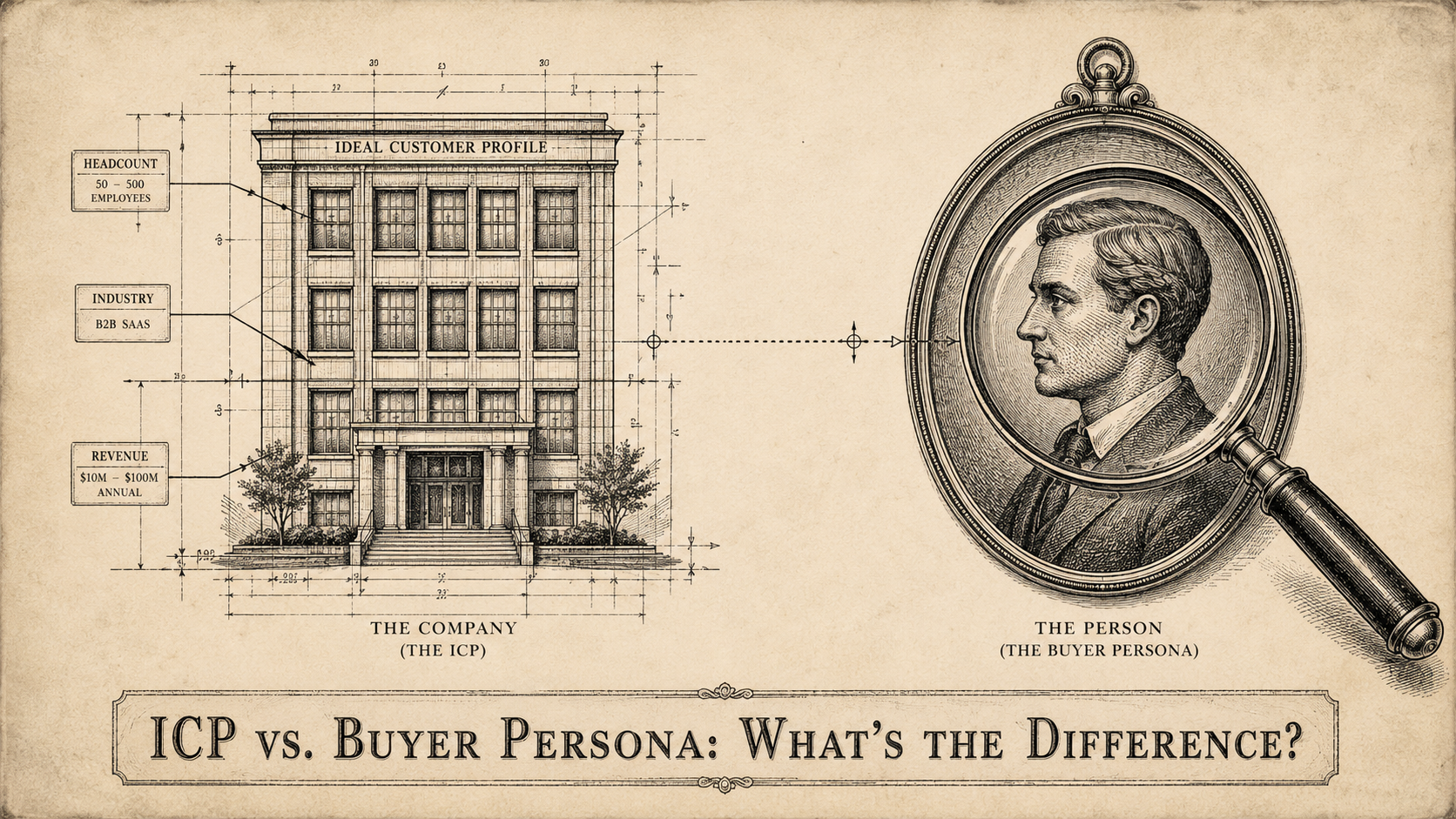
An Ideal Customer Profile (ICP) describes the company you're targeting: industry, headcount, revenue band, tech stack, funding stage, geography, and so on. It's a filter applied at the account level - does this company even belong on our list, before anyone talks to a single human there. A buyer persona describes the person inside that company you actually have to convince: their job title, what they're measured on, what they're afraid of getting wrong, and who they have to loop in before they can say yes.
The two answer different questions. ICP answers which companies should we go after - it's what sales and marketing use to prioritize accounts, build lookalike lists, and decide where ad spend or outbound effort goes. Persona answers who at that company do we need to reach, and how do we talk to them - it's what shapes messaging, content, and how a rep actually opens a sales conversation.
They get conflated because a lot of persona docs are really just an ICP with a name stapled on. E.g. Sarah, VP of Sales at a 50-100 person SaaS company is firmographic data wearing a human costume, not a persona. A real persona has to say something about the person: what she's already tried that didn't work, what she has to justify to her CFO, whether she's the one who signs or just the one who gets blamed if the tool flops.
This split matters more once a deal involves more than one person. A company can match your ICP perfectly and still not close, because the champion who loves your product isn't the decision maker and the one holding the budget - and the economic buyer, the technical evaluator, and the day-to-day user are three different personas with three different objections, all sitting inside the same ICP-qualified account.
Small teams can get away with one page that blends both - early on there's one segment and one obvious buyer, so the distinction is academic. The split earns its keep once you're selling into more than one segment, or once deals routinely involve a buying committee instead of a single contact, because at that point who do we target and how do we talk to each of them stop having the same answer.
If your team can describe your ICP but draws a blank the moment someone asks who inside that company is accountable for signing the contract, that's the exact gap our GTM Strategy - From Scratch work is meant to close.

Ready to Build Your GTM?
Whether you're launching from scratch or fixing what's broken, we'll help you get to revenue faster.